
Ahhhhhh!!!!
Okay, so this started as me writing some observations from a collection of academic articles I wanted to read to discuss in something I’m writing. I have instead gone insane. So please, have these words.
While working on something else, I have found myself finally actually reading some of the conversation analytic research by Speer and colleagues on interactions between psychiatrists and trans people in a UK gender identity clinic. I’ve been aware of these studies for a looong time but have not really paid attention to them. I have at various points skimmed the data extracts before determining that the paper was clearly taking the clinician’s side and neutralising the ickiness of psychiatry’s treatment of trans people. And, yeah, I was right. And I’m not the only one to note this. But actually taking a look at them for realsies recently, I’m quite confronted by the actual degree of their obvious (gender) troubles, from presumptive cisnormativity on the one hand to explicit antagonism of trans people on the other.
If you know me, you know ethnomethodology, conversation analysis, and discursive psychology (EMCA/DP) are not just what I do but are so very very important to me as attitudes to life. (If you don’t know me or what EMCA/DP are, feel free to start HERE 🙂 ) Not least of all, the importance of EMCA/DP to me is in part due to ethnomethodology’s indebtedness to trans people for many of it’s key working principles (as per Garfinkel, 1967).
Another thing one would know of me is that I am often concerned with the absence of trans stuff (participants in interactional data, analysts, relevant or inclusive topics, orientation to not only trans people’s unique adequacy but their unique stakes in relation to gender) in the the last decades on EMCA/DP work. In the deafening silence of EMCA/DP’s cisnormative presumption there are only a few whispers of trans people and allies. But trans people are generally present only in an instrumentalised fashion, in which Agnes (described in language barely less problematic than the psychiatric slurs of the UCLA clinic in which Garfinkel interviewed her decades previously) is paraded to make a point about how gender works, only to then uncritically examine cisnormativity into participants’ interactions by arbitrarily halting analysis riiiight before explicating some key seen-but-unnoticed presumptions, rendering them seen-but-unnoticed even by the analysts seeking to explicate them. Ironically, Kitzinger’s (2005a; 2005b; Land & Kitzinger, 2005) work on the heterosexist presumption in which she showed exactly how heterosexuality is produced as tacit background should serve to how we can engage an analytic attention to the interactional constitution of the cisgender et cetera principle (Garfinkel, 1967). Or, index-cis-cality?
Back to these papers. They constitute a substantial proportion of the conversation analytic research on trans stuff (as defined above). However, as mentioned, they quite transparently take the psychiatric stance towards trans people and the medical gatekeeping process. The papers present analyses of a few specific interactional phenomena, namely the psychiatrist’s use of, and trans people’s responses to, a hypothetical question (variants of “imagine for some reason you cannot proceed to surgery, what would you do?”). Another focus was on how comments about the trans person’s appearance were occasioned, produced, and managed. Unfortunately, they are not just participating in the psychiatric gaze, as is common in academic literature about trans people. They launder the ideas of a specific antagonist of trans people, Dr Richard Green. Green is notorious in trans circles. He also has an interesting connection to EMCA/DP (which also just happens to be the same reason for his notoriety amongst trans people). In 1958, Harold Garfinkel, working at UCLA with psychiatrist Robert Stoller, met Agnes, his interviews with whom formed the basis of the passing chapter and a central text in the development of ethnomethodology. Four years later, the UCLA gender identity research clinic was founded and co-led by Robert Stoller and… Wanna guess? Dr Richard Green!
[Side note: Richard Green wrote this glowing, adoring review of the book that Stoller wrote about the his psychodynamic theory of gender and transsexualism. It’s gross. He wrote it in 2010. He quotes himself from 1972, about how they chose to torture children deemed gender non-conforming with experimental behavioural conversion treatments in order to minimise the number of trans adults, saying ‘‘While privately, one might prefer to modify society’s attitudes toward cross-gender behavior, in the consultation room with an unhappy youngster, one feels far more optimistic about modifying the behavior of that one child than the entire of society’’ (Green et al., p. 217). He immediately continues by saying how he was right. This guy hated trans people.]
I’m not too clear on the timing as my frantic googling has provided inconsistencies, so I’m not sure what kind, if any, of relationship Garfinkel and Green had. This paper claims that Garfinkel was introduced to Agnes by Stoller and Green (O’Brien, 2016) but from what I can see Green didn’t come to UCLA until later. So, *shrugs*. But how wild that they both have such impacts on trans people even now, eh?
Returning to these CA papers of the UK NHS gender identity clinic interactions. I’m quite frustrated by my own ignorance. It was no secret; his name is on the papers. Ironically, though, this ignorance is the result of having given only minimal attention to these papers at all in the past to due it being immediately apparent they took the psychopathology of being trans for granted. But what follows below is my relatively stream-of-consciousness unravelling of both my mind, and the overtly distressing characterisation of trans people and the practical methods by which their medical oppression is accomplished. I think its important to present this because (briefly):
- Its the result of a multi-day hyperfixation and the cost to my sanity is too great to leave unshared.
- It feels quite lame to have been ignorant to this real obvious shit. These are 20 year old papers. The only acknowledgement of the pathologising framework adopted in these papers I’ve seen is from Borba (2019; more on this below, because I think their critique misses the mark in a significant way).
- I think its important that trans people (possibly fellow hyperfixators, or students and possible future analysts) don’t see this stuff unacknolwedged in our field and think it represents an acceptable or exemplary case of EMCA/DP’s approach to gender, or of the field and its constituent community of analysts.
Important Note: What you see below is presented largely as it came out of my noggin over a the last few days. It is a bit of a meandering road, but I appreciate the company.
***
A few days ago I posted on Bluesky about a quote from a footnote in Speer and Green (2007):
Although the patient does not know whether the psychiatrist is gay or straight, being treated as a woman by a man in a heteronormative culture, may be the ultimate validation of one’s passing – and a testament to the mutually co-implicative relationship between gender and sexuality.
[Future me here: Note that at this point I hadn’t paid attention to who the authors were.]
In this paper, the authors are analysing how a trans woman and psychiatrist do, and deal with, descriptions of the trans woman’s appearance. Specifically, they analyse how the patient reports third parties’ compliments on her appearance, how the psychiatrist responds to this report, they trouble in interaction this produces and then the psychiatrists affirmation of the patient’s appearance as a woman. I think the analysis is weird (I might write up a specific criticism of the analysis at some point). One of my weird (?) habits in reading papers is to skim through for footnotes and endnotes. I like to read them first so I know what they say when I get to them while reading. In this chapter, there were two footnotes that caught my eye. They are clearly presented as footnotes because they are highly speculative comments, but maybe that would lead one to ask, “why include them?”. Both the footnotes that caught me make claims to the significance of the trans woman patient’s behaviour that construe her engaging in stereotyped, flirtatious, expressions. The trans woman states she is attracted to men, but Speer and Green feel the need to make sure we know she might be saying what she is saying and doing what she is doing because she attracted to men, and oh I don’t know, maybe she’s attracted to this man? Who could say?
When I posted this quote on Bluesky, I also noted that this chapter was published in a book on queer perspectives in psychology in 2007 and described how this kind of thing, the presumption that trans women do the things they do in transitioning in order to sexually appeal to heterosexual men, was/is a notorious transphobic trope often weaponised against trans women by transphobes and terfs who often, in highlighting our supposed hypersexuality, suggest they hope we would get the kind of attention from men usually reserved for woman (i.e., sexual assault). Like, women who get slut-shamed and victim-blamed for sexual assault or rape due to their “asking for it” (i.e., wearing clothes showing too much skin or whatever), trans women are seen to be asking for it by merely wearing a dress, or having a name commonly considered feminine. That this queer psychology book published this chapter, with this author, knowing who he was, is quite disappointing and frustrating, with this very clear and overt terf talking point in it, its quite disappointing. Yes, 20 years is a long time. But in 2007 I was 16 and this message was literally everywhere. But people didn’t really care about us then.
Anyway. After posting that I let it sit for a bit. However, as I needed to actually write this other thing I came back to the desk and tried to look at the chapter again. As I was once-more skimming a section of it, I read this, a footnote on the first page (Speer & Green, 2007, p. 335):
The first author wrote this chapter and conducted all the analyses. The second author arranged access to the field site, coordinated the collection of data at that site, and provided brief explanation on the clinical management of patients. He is the psychiatrist whose interactions are analysed in this chapter. (bold mine).
I’d never really thought to look at the other authors as I knew Speer is a CA person (whose other research is great). But this footnote made it all suddenly click together. I looked again at the chapter’s title page, and the psychic injury incurred was instantaneous.
[I’ve included more contextualising info on Green above, which you’ll likely have read. This is what I wrote at the time.] Dr Richard Green founded the Archives of Sexual Behaviour (a journal notorious for transphobic publications by infamous science cranks Ray Blanchard, J. Michael Bailey etc, and peddler of transphobic talking points like Rapid-Onset Gender Dysphoria). He was a conversion therapy pioneer. While he is often described as an LGBT ally for his later agreement that homosexuality should be removed from the DSM, he was at that same time in the working group that introduced gender identity disorder into the DSM based on his work with Robert Stoller to whom is commonly attributed the coining of “gender identity”.
So, Richard Green:
- is one of the most important men in the modern academic- and state-sanctioned abuse of queer and trans children,
- practically co-invented the scheme by which being cis rendered commonsensically natural, normal, universal, such that trans people are disordered and abnormal.
- argued converting gay (or possibly gay) children is bad because gay adults are fine, but that converting trans children is fine because trans adults are bad and disordered.
- wrote conversation analytic study of the exact institutional activities for which he is jointly, directly responsible for. While he is named, there is no discussion, other than the footnote above, addressing his stake in a particular version of things being presented about what he does, how he does it, why he does it as the original proponent of it. Absolutely egregious conflict of interest, especially as a grant was received for this project.
- imputed absolutely unevidenced sexual motives into his own patient (sexualising her), suggesting the patient is in fact the one sexualising him.
This suddenly made a lot of sense.
***
[Future me again: After the damage of the Richard Green recognition I was skimming through the papers again, the tone and focus now making a lot more sense to me. I’m not sure how (presumedly because I just had all of the papers associated with this project open in my PDF reader), but I ended up fixated on two segments in a different paper on the same project. The following comments concern some paragraphs from the intro/lit review and from the discussion of Speer and Parsons (2007), which appeared in an edited collection on discursive psychological research. The below quotes come from p. 183-183. Having just described what the putative principal concerns are for the psychiatrist and trans people in these interactions, the authors go on to describe the tensions that arise due to the differences in these concerns. As you’ll see, I went line-by-line here (it was going to be a Bluesky thread) and the style is a bit more casual. I’m going to leave it that way here. Let’s go.]
The contrasting concerns of psychiatrists and patients generate a number of tensions within the treatment context.
Sure, this is pretty normal and common, especially in institutional, and especially especially in medicine.
Commentators have noted that patients, concerned not to delay or risk being refused surgery, are unlikely to report any ambivalence about their chosen gender identity, believing (often correctly) that it will be a ‘contra-indication’ for surgery.
Who are these commentators? (Hold that thought). These commentators supposedly claim that trans people are unlikely to report questions, concerns, or doubts about their gender and desire for surgery. But, do they have those doubts? Maybe that ‘ambivalence’, to use the authors’ term, is just not really common? Multiple studies have since demonstrated that trans people’s rates of regret regarding surgery are lower than almost any other medical treatment (as well as life events like having children or getting married). So this is just cis nonsense, taking for granted that trans people withhold their true feelings in order to get what they want. This is what Robert Stoller said after he was “shamed” by Agnes’ gender reveal and the subsequent retractions Stoller had to make. So where did Speer and Parsons get this idea? Who were those “commentators”?
Similarly, they actively resist suggestions that they have a ‘gender problem’, and simply repeat a stereotyped gender narrative found commonly in ‘the published developmental histories of transsexuals who preceded them’ (Green, 1987: 7–8, 1974; Stone, 1993), claiming, for example, that they have ‘always felt’ this way – that they are a ‘woman/man trapped in a male/female body’ (Raymond, 1994: xvi).
Oh look! Those commentators were Richard Green and Janice Raymond. A conversion therapist and a TERF. Again, the fact that Green is playing multiple roles here (project collaborator, institutional access, institutional informant, participant, originator of the gatekeeping process) is not made explicit. Quoting himself saying (to the effect of) “The transes make our job hard by coming in prepared for our antagonism and deceiving us” as the motivation for this study is (surely) transparently a conflict of interest and bad research practice.
That quote, “‘the published developmental histories of transsexuals who preceded them” is attributed to Green, but is also accompanied by the citation Stone, 1993; this is Sandy Stone’s The Empire Strikes Back: A Posttranssexual Manifesto, which is a foundational text of trans studies in which Stone responds to the accusations of lying from people like Richard Green And Janice Raymond, but the authors do not give her any space and so make it look like transsexual hero Sandy Stone was just straightforwardly saying the same thing as Green. (Note, she says some trans people do this, but she places this kind of conduct correctly as a response to psychiatric hostilities against us which trans people must yet navigate. Bigots love to reverse the order of things (for more on this temporal switching, ironically called ‘transpositioning’, for bigot reasons, see Maynard 2019; note, as well, that Maynard focuses on abuses against autists. Interesting that there are parallels, eh? She said, knowing full well that the applied behaviour analytic project benefitted from the torture of both autists and trans people).
The other name here is Raymond. This is of course Janice Raymond, ArchTerf, and author of the book from which all terf nonsense largely draws from, The Transsexual Empire (originally published in 1979, but the cited edition is from 1994) . This is the woman who said (among other things):
- “Finally, and I think most important, there are more male-to-constructed-female transsexuals because men are socialized to fetishize and objectify. The same socialization that enables men to objectify women in rape, pornography, and “drag” enables them to objectify their own bodies. In the case of the male transsexual, the penis is seen as a “thing” to be gotten rid of. Female body parts, specifically the female genitalia, are “things” to be acquired. Men have always fetishized women’s genitals. Breasts, legs, buttocks are all parts of a cultural fixation that reduces women not even to a whole objectified nude body but rather to fetishized parts of the female torso.” (p. 29-30)
- “Rape, of course, is a masculinist violation of bodily integrity. All transsexuals rape women’s bodies by reducing the real female form to an artifact, appropriating this body for themselves. However, the transsexually constructed lesbian-feminist violates women’s sexuality and spirit, as well. Rape, although it is usually done by force, can also be accomplished by deception. It is significant that in the case of the transsexually constructed lesbian-feminist, often he is able to gain entrance and a dominant position in women’s spaces because the women involved do not know he is a transsexual and he just does not happen to mention it. The question of deception must also be raised in the context of how transsexuals who claim to be lesbian-feminists obtained surgery in the first place. Since all transsexuals have to “pass” as feminine in order to qualify for surgery, so-called lesbian-feminist transsexuals either had to lie to the therapists and doctors, […]” (p. 103-104).
This should all sound very familiar. It is what motivates modern bathroom panics about trans people. In fact, Raymond just after that last quote, says that trans women, having lied to get surgery, become miserable, “reverting to masculinity” (p. 104), which they achieve by trying to seduce lesbian feminists. To Raymond:
“Because transsexuals have lost their physical “members” does not mean that they have lost their ability to penetrate women—women’s mind, women’s space, women’s sexuality. Transsexuals merely cut off the most obvious means of invading women so that they seem noninvasive. However, as Mary Daly has remarked, in the case of the transsexually constructed lesbian-feminists their whole presence becomes a “member” invading women’s presence and dividing us once more from each other.” (p. 104)
Returning to Speer and Parsons (2007):
Thus, the practitioner–patient consultation has been described as an ‘adversarial encounter’ (Newman, 2000: 399), which results in a ‘cat-and-mouse’ game that mitigates against the goals of both psychiatrists and patients.
This is clearly not the case. In using Newman’s term ‘adversarial encounter’, Speer and Parsons have adopted the characterisation of the psychiatrist/trans person dynamic as two parties in opposition to each other. Trans people being resentful of the psychiatric process to get medical care does not entail that trans people approach these interactions as one in one they can/should/will fight back, as an adversary would. The taken-for-granted presumption of the whole psychiatric requirement for surgery is that the institutions response to requests for surgery is presumptively “no, unless…”. Trans people cannot get surgery through any other means. Recognising that a person or profession works as a restrictive gatekeeper on the presumption of doubt about people’s self-reported requirement for surgery is not adversarial; it’s the result of being doubted, about exactly this, by everyone forever, especially from doctors and other professionals who can exert punishing force over us. Being frustrated by the requirement to be seen not to be lying or tricking them when the entire world treats us as liars and tricksters, treating our demonstrations of our experiences with suspicion is not adversarial. It is not the case that both psychiatrist and trans person are mutually frustrating each other in some kind of game. Like, is it manipulation when cis women expect, and prepare for, being dismissed or doubted about conditions causing them distress, difficulty, or harm? No, we tend to call that a requirement under patriarchy/sexism. So why are trans people not afforded the same recognition? Ironically, in real life and not a “game”, cats chase, maim, and eat mice.
Its only really possible to think that both parties are mutually impeded if you have an odd idea about what the stakes are for each participant. Luckily, the next sentence shows us how true that is.
So, for the psychiatrist the issue is ‘how can I be sure that this person is a ‘‘true transsexual’’ and not just telling me what they think I want to hear in order to obtain treatment?’ For the patients it is ‘how can I convince this sceptical psychiatrist that I am a true transsexual, and tell him what I think he wants to hear in order to get my treatment?’
Interesting. So for the psychiatrist, the available possibilities for who the trans patient is are a “true transsexual” and someone who lies to say what they think will get them “treatment”. Like, if that’s what they think is going on for psychiatrists, then what you have here are studies of the practical accomplishment of paranoid doubt by psychiatrists. (And have no doubt that I’m being sincere saying that; these papers say so much more about cis nonsense than about trans people). What other reason could people have to deal with (among all the rest) the temporal horror that is the NHS waitlist other than that it is just earnestly what they want for themselves to live a comfortable life with less/no dysphoria? What reasons do a non-trans person have to “obtain treatment”?
To answer this, lets go to the movies (quickly, but then to the library coz the movie doesn’t have all the juicy bits). In Silence of the Lambs, the criminal (cannibal) psychiatrist Hannibal Lecter says the sadistic serial killer Buffalo Bill came to him seeking to change sex. Dr Lecter said no, on the basis that he wasn’t truly a transsexual. In the novel (the movie leaves it out mostly), Buffalo Bill gets more background. His name was Jame Gumb, which is explained as negligence from his parents in completing the paperwork when he was born. He was abused throughout his childhood before ultimately murdering his grandparents and being incarcerated in a psychiatric facility. So, Jame was fucked from the beginning, we learn. We also learn that he was gay and after he discovered the man he was seeing was having an affair Jame murdered him and the man he had the affair with. Hannibal rejects Jame’s request for surgery on the basis that he isn’t really trans, he is an insane, abused, homophobic (and self-hating) gay man. And of course, the insanity is pumped way up when he resolves to kill women for their skin. So here we have the validation/endorsement of the psychiatrist’s justified doubt about desire to change sex; which sucks. But in this fiction, the psychiatrist’s rejection is justified as Jame isn’t trans, he’s just fucked, evidenced by the irrationality of symbolically changing sex by wearing woman-skin suits.
The point is that, yes, actually the psychiatrist is generally oriented to the issue as described by Speer and Green above; true transsexual versus faker. But the idea that the stakes for the patient are just the reverse of the psychiatrists’ is obviously cis nonsense. A true transsexual is someone who receives a diagnosis of gender identity disorder (as in this used to be the legit medical term). However, Someone persisting in seeking transition surgeries who is not a true transsexual is not automatically returned to the world an unproblematic cis person; because being so can warrant further (casual or more formal) psychiatrisation due to the ostensively obvious irrationality of their seeking surgery. What other reasons indeed! Delusion, gullibility, sexual paraphilia, autism, personality disorders, underlying self-directed homophobia. Autism, for example, is seen as a common confound that should rightly disrupt trans health care, as well as borderline personal;ity disorder, as they are seen to impair our ability to understand our identity such that we might just be really confused and not actually trans. Currently, now, 2025, there are countries who won’t allow trans people to receive transition medical care until issues associated with autism are resolved (which, practically, means never because autism isn’t something that gets resolved). Under this scheme, the trans person loses autonomy and epistemic primacy over their experiences regardless of which one the psychiatrist lands on. The trans person is crazy either way.
Moving now to the end of this paper, the last two paragraphs of Speer and Parsons (2007, p. 197) read:
We want to end by considering the extent to which the psychiatrist’s questioning strategy can be considered successful. On the one hand, we could argue that transsexual patients are already very skilled at managing a difficult situation. They respond actively and creatively to the demands of the encounter and manage well within a problematic set of constraints. In this sense, psychiatrists may be losing the ‘cat-and-mouse’ game and may need to ‘up their game’ so that patients are not continuously second-guessing them and tailoring their responses and their life narratives accordingly.
On the other hand, although the patient’s response to the hypothetical question may appear troubled, this does not necessarily mean that the psychiatrist’s questioning strategy is unsuccessful, or that they are bad, hostile, insensitive gatekeepers. Indeed, as we have shown, the psychiatrist may intend to make things difficult for the patient, put them ‘on the spot’, or make them think that their answers will be inconsequential, in order to avoid precisely the kinds of second-guessing and stereotyped narrative scripts alluded to in the literature, and make an accurate differential diagnosis. Psychiatrists are in a difficult situation here, and it is hard to imagine an alternative means by which they may produce a reliable diagnosis, and without somehow troubling the patient. Even though the psychiatrist’s questioning seems hostile, then, we must ask, given the current socio-legal and medical context within which they must work, could the psychiatrist proceed in any other way? If so, how?
Of course, “successful” means…? Whose success? Reading these two paragraphs cements what is abundantly clear across all of these papers; trans people are living in the psychiatrists’ world, and so apparently are the authors of these papers. Taking for granted that hypothetical questions are a diagnostic tool, the authors return to their childish “game” metaphor to suggest that, as if in a competition, trans people are winning and the psychiatrists need to improve their tactics. Or what? Trans people will actually get the care they need?
Despite paying lip service to trans perspectives, these papers largely unquestioningly accept the institutional perspective and role of psychiatrists as rightfully (but not according to the pesky trannies) and properly working in good faith to ensure only the people who should get surgery get surgery. The phrasing “make them think that their answers will be inconsequential, in order to avoid precisely the kinds of second-guessing and stereotyped narrative scripts alluded to in the literature” is an admission that this is not the case. In fact, this is an admission that psychiatrists attempt to pre-empt the lying that they presume trans people will do by lying themselves first! What else could it mean that, in the service of pursuing an “accurate diagnosis”, the psychiatrist has to lure the trans person into believing (“make them think”) that things they say are off the record and will not be used for decision making (“that their answers will be inconsequential”) when they actually will be?
So I guess psychiatrists can be suspicious about their patient’s intentions, lie to them that they can enjoy total candor, and then use that information to do exactly what they say it wouldn’t be used for and its just (‘just’ as in merely, but also as in justice) professional medical practice, but the possibility that trans people prepare for being treated with exactly the kind of skepticism from psychiatrists that they describe as a professional tool they admit to using is always potentially weaponisable against us.
That final paragraph reads like a lament for the plight of the earnest psychiatrist:
Don’t think the medical gatekeepers “bad hostile, or insensitive” when they have to trick and test and doubt the people who go to them for help. They have to do it because trans people are too organised and strategic. Its trans people’s fault (as well “the current socio-legal and medical context”). (My paraphrasing).
In the same year the book with this this chapter was published (2007), Talia Mae Bettcher published what is now a modern classic of trans studies “Evil Deceivers and Make-Believers”, in which she draws on Garfinkel’s natural attitude to sex (the presumptions that [cis] people take for granted about people and sex that naturalise a cisgender order) to explain how trans panic murder defences rely on cis people’s tacit scepticism and distrust of trans people.
***
I mentioned at the beginning that I knew of one explicit recognition of the transphobia of these studies. Rodrigo Borba (2019, p. 23) had this to say regarding Speer et al.’s work:
Speer’s allegiance to the conversation analytic understanding of context as co-text (Billig 1999), and her focus on what members explicitly orient to, impel her to take the status of transsexuality as a mental disorder for granted. As such, her CA studies overlook the centrality of pathologising discourses to the relationships within the gender clinic that she investigates.
Borba ascribes the clear focus on institution-side matters and exclusion of anything critical of the serious medical gatekeeping Speer and co-authors analysed on two things, (1) the conversation analytic understanding of context as locally co-produced, and (2) the focus on members displayed orientations. What annoys the hell out of me is that this isn’t a problem with ethnomethodology, conversation analysis, discursive psychology. Those two points are both key aspects of EMCA/DP work and feminist conversation analysis is well established (and were at time of Borba’s comment). I don’t think the problem is that conversation analysis inevitably normalises, or cannot be used to address, big, critical, projects (which has been clearly demonstrated); it’s the (cis) people doing the analysis and writing the papers that are the problem. It feels more relevant that one of the heads on this project was a decades-long trans conversion practitioner and co-architect of the modern anti-trans psychiatric project, and that all the people around this project (for example, the conversation analysts who read and gave feedback on manuscripts, in data sessions etc. and the academics who put together the books in which Speer & Green (2007) and Speer and Parsons (2007) were not immune to society’s cisnormativity.
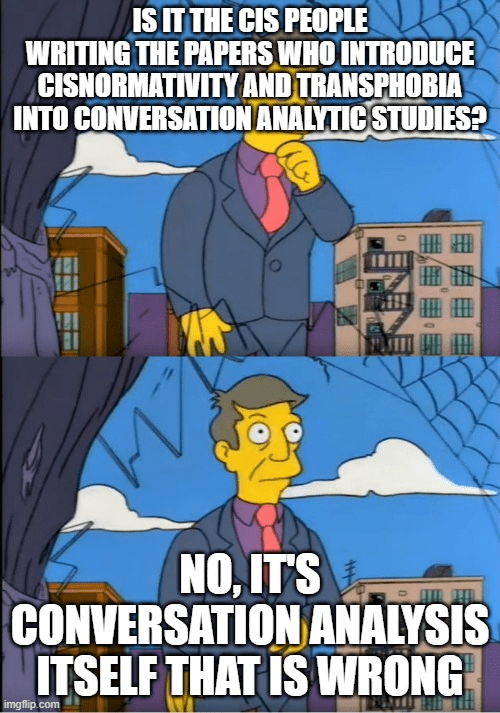
[I want to note that I love Rodrigo Borba’s work on gender identity clinic interactions. Excellent shit. This is but a gentle ribbing. Borba (2019) and Borba and Milani (2019) are excellent papers, that I’d read before many times and are only even better in conversation with Speer et al.]
***
Speer et al.’s papers constitute a huge portion of conversation analytic studies of trans related stuff. There really are not many of them. So, it’s devastating that what is there hurts two of the things I love most; trans people and conversation analysis. But, frankly, considering the lip-service paid to trans people’s distress at the policing of our bodies, and how Speer (2010) ends a description (in a queer psychology textbook) of “on why I study trans” (p. 89; not a typo, people used to refer to trans like it was a thing), I’m certainly glad there wasn’t more if it was to be driven by the “hope my work will feed into improvements in the current treatment of transsexualism and gender identity disorder” (p. 89-90) when in the same year her co-author was publishing the virtues of Stoller’s book and the project of limiting not just who receives transition-related (medical care), but who deserved it (Green, 2010). 2010 was the year I first started university, having begun transitioning three-to-four years earlier. I started seeing a GP that year at my university for a referral to an endocrinologist to begin hormone treatment (having been denied it before coming to university despite being over 18). The doctor I saw assured me they would write the referral; they never did. They arbitrarily set me back. Years later I found their comments about my appearance, my body, my clothing, my mannerisms in my medical records. Though not linking the appearance to the non-referral, the GP described me as masculine and commented on the out-of-placeness of my love of pink and my clothing choices considering that fact. The only way these papers could help to improve treatment of trans people (to give the benefit of the doubt here) is by further demonstrating to people the sheer antagonism of the system.
The histories of EMCA/DP and trans people are intertwined. Trans people have given a lot for us to have the analytic attitude we think is so significant. Remember, your analyses come at the cost of trans people abused in the UCLA gender identity clinic. What can EMCA/DP give in return?
Examples of EMCA/DP Studies that Don’t Treat Us Like Shit
This list is not at all exhaustive, but they are nice examples of recent empirical EMCA/DP research that addresses trans people and issues related to transphobia, trans rights, cisnormativity etc. They are recommended reading:
Edmonds, D. M., & Pino, M. (2023). Designedly intentional misgendering in social interaction: A conversation analytic account. Feminism & Psychology, 33(4), 668–691. https://doi.org/10.1177/09593535221141550
Henderson, E. F. (2022). ‘So, it’s not necessarily about exclusion’: Category use in naturally occurring transphobic talk. Journal of Language and Discrimination, 6(2), 213–240. https://doi.org/10.1558/jld.21376
Henderson, E., & Tennent, E. (2025). Sex, Gender, and Bodies: Transmisogyny and Garfinkel’s Status Degradation Ceremony. Symbolic Interaction. https://doi.org/10.1002/symb.1231
Katsiveli, S. (2021). ‘It is this ignorance we have to fight’: Emergent gender normativities in an interview with Greek transgender activists. Gender and Language, 15(2), 158–183. https://doi.org/10.1558/genl.18949
Pino, M., & Edmonds, D. M. (2024). Misgendering, Cisgenderism and the Reproduction of the Gender Order in Social Interaction. Sociology, 58(6), 1243–1262. https://doi.org/10.1177/00380385241237194
I also think these are both nice discussions that recognise the significance of, and capacity for, of ethnomethodological approaches to develop excellent empirical accounts of the production of identities of all kinda but focusing on queer and trans inclusion:
Crawley, S. L. (2022). Queering Doing Gender: The Curious Absence of Ethnomethodology in Gender Studies and in Sociology. Sociological Theory, 40(4), 366–392. https://doi.org/10.1177/07352751221134828
Crawley, S. L., Whitlock, M., & Earles, J. (2021). Smithing Queer Empiricism: Engaging Ethnomethodology for a Queer Social Science. Sociological Theory, 39(3), 127–152. https://doi.org/10.1177/07352751211026357
REFERENCES
(Incomplete; it’s a blog, not a journal)
Bettcher, T. M. (2007). Evil Deceivers and Make-Believers: On Transphobic Violence and the Politics of Illusion. Hypatia, 22(3), 43–65. https://doi.org/10.1111/j.1527-2001.2007.tb01090.x
Borba, R. (2019). The interactional making of a “true transsexual”: Language and (dis)identification in trans-specific healthcare. International Journal of the Sociology of Language, 2019(256), 21–55. https://doi.org/10.1515/ijsl-2018-2011
Borba, R., & Milani, T. M. (2017). The banality of evil: Crystallised structures of cisnormativity and tactics of resistance in a Brazilian gender clinic. Journal of Language and Discrimination, 1(1), 7–33. https://doi.org/10.1558/jld.33354
Green, R. (2010). Robert Stoller’s Sex and Gender: 40 Years On. Archives of Sexual Behavior, 39(6), 1457–1465. https://doi.org/10.1007/s10508-010-9665-5
Kitzinger, C. (2005a). Heteronormativity in Action: Reproducing the Heterosexual Nuclear Family in After-hours Medical Calls. Social Problems, 52(4), 477–498. https://doi.org/10.1525/sp.2005.52.4.477
Kitzinger, C. (2005b). “Speaking as a Heterosexual”: (How) Does Sexuality Matter for Talk-in-Interaction? Research on Language and Social Interaction, 38(3), 221–265. https://doi.org/10.1207/s15327973rlsi3803_2
Land, V., & Kitzinger, C. (2005). Speaking as a Lesbian: Correcting the Heterosexist Presumption. Research on Language and Social Interaction, 38(4), 371–416. https://doi.org/10.1207/s15327973rlsi3804_1
Maynard, D. W. (2019). Why Social Psychology Needs Autism and Why Autism Needs Social Psychology: Forensic and Clinical Considerations. Social Psychology Quarterly, 82(1), 5–30. https://doi.org/10.1177/0190272519828304
O’Brien, J. (2016). Seeing Agnes: Notes on a Transgender Biocultural Ethnomethodology. Symbolic Interaction, 39(2), 306–329. https://doi.org/10.1002/symb.229
Raymond, J. G. (1994). The transsexual empire : the making of the she-male. Teachers College Press.
Speer, S. A., & Green, R. (2007). On passing: The interactional organization of appearance attributions in the psychiatric assessment of transsexual patients. In V. Clarke & E. Peel (Eds.), Out in Psychology: Lesbian, Gay, Bisexual, Trans and Queer Perspectives (pp. 335–368). John Wiley.
Speer, S. A., & Parsons, C. (2007). “Suppose it wasn’t possible for you to go any further with treatment, what would you do?” Hypothetical questions in interactions between psychiatrists and transsexual patients. In A. Hepburn & S. Wiggins (Eds.), Discursive Research in Practice: New Approaches to Psychology and Interaction (pp. 182–199). Cambridge University Press. https://doi.org/10.1017/CBO9780511611216.010
Speer, S. A. (2010). Key Researcher: Susan Speer on why I study trans. In V. Clarke, S. J. Ellis, E. Peel, & D. W. Riggs (Eds.), Lesbian, Gay, Bisexual, Trans & Queer Psychology: An Introduction (pp. 89-90). Cambridge University Press.

 Conditionally Relevant
Leave a comment